
Plant Information
Common Name: Candelilla
Scientific Name: Euphorbia antisyphilitica
Family: Euphorbiaceae (Spurge family)
Plant Type: Perennial desert shrub
Key Compound: Candelilla wax (long-chain hydrocarbons, esters, fatty acids, resins)
Origin: Northern Mexico and the southwestern United States
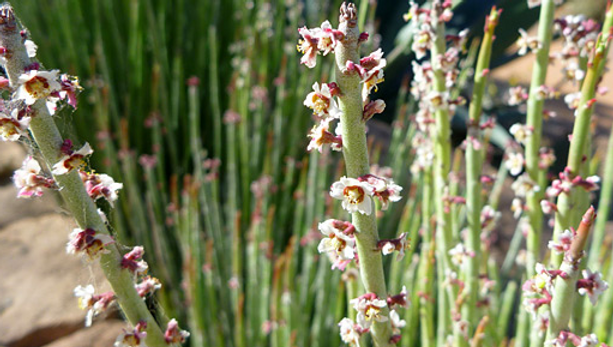
Appearance: Clusters of thin, upright gray-green stems that resemble candle sticks
About the Plant
Candelilla (Euphorbia antisyphilitica) is a desert plant known primarily for producing candelilla wax, a natural wax extracted from its stems. The name candelilla means “little candle” in Spanish, referring to the plant’s tall, slender stems that resemble candle wicks.
This plant thrives in harsh desert environments and is one of the most important natural sources of plant-based wax used in cosmetics, food coatings, and pharmaceuticals.
The wax obtained from candelilla is valued because it is firm, glossy, and highly stable, making it an excellent vegan alternative to beeswax.
How does this plant grows?
Candelilla is adapted to survive in arid desert ecosystems. Harvesting involves cutting the stems and extracting the wax through a boiling and filtration process.
The plant grows in dense clusters of narrow stems.
Small leaves appear briefly but fall off quickly to conserve water.
Tiny pink or white flowers bloom occasionally during favorable conditions.
The wax naturally forms on the outer surface of the stems as a protective coating.
Skin Care Benefits
Brassica campestris seed oil is valued in skincare due to its nutrient-rich lipid profile.
Moisturizing and Emollient - The oil contains essential fatty acids that help hydrate the skin and prevent moisture loss.
Skin Barrier Support - Fatty acids such as linoleic acid help reinforce the skin barrier and maintain softness.
Antioxidant Protection - The presence of vitamin E and phytosterols helps protect skin from oxidative stress caused by pollution and UV exposure.
Anti-Inflammatory Effects - Compounds in the oil may reduce mild inflammation and irritation.
Skin Conditioning - The oil provides a smooth, silky feel, improving the texture and spreadability of cosmetic formulations.
Reasons People Use Candelilla in Skincare
Manufacturers and formulators prefer candelilla wax because it is:
• Plant-based and vegan
• Highly stable in cosmetic formulations
• Able to improve product texture and thickness
• Effective at protecting the skin from moisture loss
• Compatible with many natural ingredients
It is particularly valuable in solid or semi-solid cosmetic products such as balms and sticks.
Clinical Findings
Scientific studies have examined the physical and protective properties of candelilla wax.
Skin Barrier Function - Research suggests wax-based emollients help reduce transepidermal water loss (TEWL), supporting skin hydration.
Formulation Stability - Studies show candelilla wax improves the structure and stability of cosmetic products, particularly emulsions and lip formulations.
Biocompatibility - Candelilla wax is considered safe and non-irritating for topical use and is widely approved for cosmetic applications.
Antimicrobial Support - Some studies suggest waxes can contribute to protective barriers that help reduce microbial contamination on skin surfaces.
The Science
The wax is extracted from the stems by boiling the plant material, which causes the wax to separate and float to the surface. It is then refined and purified for cosmetic use.
These compounds give the wax its:
hardness
glossy appearance
high melting point
protective barrier properties
Ancient Medicine Usage
Indigenous communities in northern Mexico historically used candelilla plants for practical and medicinal purposes.
Traditional uses included:
coating materials for waterproofing
making candles
protecting leather and wood surfaces
herbal remedies for minor skin issues
The plant’s wax coating made it valuable for protective and preservative uses long before its adoption in modern cosmetics.
Symbolism of this Plant
Because of its resilience in harsh desert environments, candelilla is often associated with:
Resilience and endurance - Its ability to survive extreme drought symbolizes strength and adaptation.
Light and guidance - The plant’s candle-like stems inspired its name and are associated with illumination and clarity.
Protection - The wax that coats the plant represents natural protection and preservation.
References
Information based on research and publications from:
Cosmetic Ingredient Review (CIR) – Safety assessment of candelilla wax
Journal of Cosmetic Science – Waxes in cosmetic formulations
USDA Plant Database – Euphorbia antisyphilitica
Handbook of Cosmetic Science and Technology – Natural wax ingredients
Botanical resources on desert plants of North America