
Frankincense
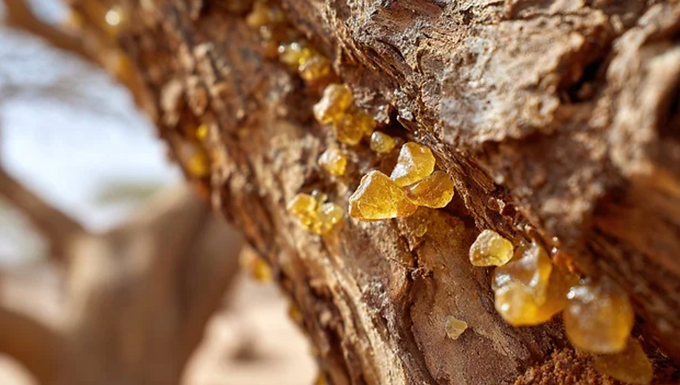
The frankincense tree (Boswellia sacra) is a desert tree that produces aromatic resin used for thousands of years in medicine, skincare, and religious rituals. The resin contains boswellic acids and aromatic compounds that provide anti-inflammatory, antioxidant, and soothing properties.
Plant Information
Common Name: Frankincense
Scientific Name: Boswellia sacra
Family: Burseraceae
Plant Type: Small deciduous resin-producing tree
Key Compound: Boswellic acids, alpha-pinene, limonene, incensole
Origin: Arabian Peninsula and northeastern Africa
Appearance: Small tree with papery bark, twisted branches, and aromatic resin that hardens into golden “tears”
About the Plant
Frankincense trees grow in rocky desert regions and can survive in very dry soil and extreme heat. The trees produce resin as a natural protection mechanism when the bark is wounded.
Farmers make small cuts in the bark, and the resin slowly flows out and hardens into fragrant pieces. After harvesting, the resin is processed to produce essential oil, incense, and traditional medicines.
Frankincense oil is obtained by steam distillation of the resin that comes from the bark of Boswellia trees.
How does this plant grows?
Frankincense trees grow naturally in dry, rocky desert environments.
Seed germination – seeds sprout in rocky soil.
Early growth – young trees develop thick bark and twisted branches.
Maturation – trees develop resin-producing bark.
Resin harvesting – small cuts are made in the bark to release sap.
Resin hardening – sap dries into golden resin tears that are collected.
Frankincense trees are extremely resilient and can survive in harsh desert environments.
Skin Care Benefits
1. Anti-aging support - Helps reduce the appearance of fine lines and wrinkles.
2. Skin soothing - May calm irritated or inflamed skin.
3. Improved skin tone - Often used to help even skin tone and improve brightness.
4. Wound and scar care - Traditionally used to support skin healing and reduce scar appearance.
5. Antimicrobial effects - May help protect the skin from harmful microbes.
Reasons people use Frankincense Oil:
Frankincense is valued in cosmetic formulations because it:
Helps soothe irritated skin
Supports healthy skin appearance
Contains natural antioxidants
Provides a pleasant aromatic scent
Has a long history of medicinal use
It is especially popular in luxury and anti-aging skincare products.
Clinical Findings
Scientific studies have examined compounds found in frankincense resin.
Research suggests that boswellic acids, natural compounds in the resin, may have:
Anti-inflammatory properties
Potential immune-supporting effects
Possible antimicrobial activity
Some studies also investigate frankincense extracts for joint health and inflammatory conditions.
However, more clinical research is still needed to fully confirm all therapeutic uses.
The Science
Frankincense essential oil contains several important natural compounds, including:
Boswellic acids
Alpha-pinene
Limonene
Incensole acetate
These compounds are believed to contribute to its:
Anti-inflammatory effects
Aromatic therapeutic properties
Skin-protective effects
The oil is typically extracted through steam distillation of the resin.
Ancient Medicine Usage
Frankincense has been used for thousands of years in traditional medicine.
Ancient civilizations such as those in:
Ancient Egypt
Ancient Greece
Ancient Rome
Used frankincense for:
Religious incense
Healing ointments
Perfumes
Wound treatment
It was also traded along the famous Incense Route, one of the most important trade networks of the ancient world.
Symbolism of this plant
Frankincense has strong spiritual and cultural symbolism.
It often represents:
Purification
Sacred rituals
Healing
Spiritual connection
It is famously known as one of the three gifts mentioned in the story of the birth of Jesus Christ.
References
Information based on research and publications from:
World Health Organization medicinal plant reports
National Center for Complementary and Integrative Health
Aromatherapy and medicinal plant research journals
Ethnobotany studies on the Boswellia genus